


Join Our Email List!

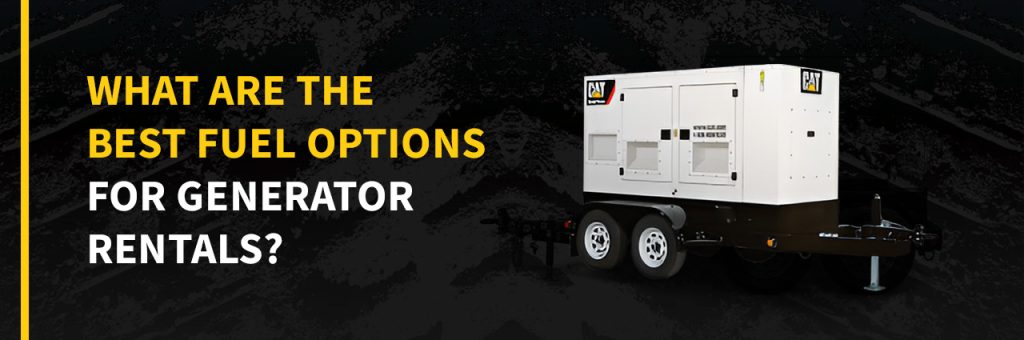
Fuel type plays a significant role in choosing the right generator rental. Fuel can affect operational efficiency and site compliance, impacting your overall project budget. Understanding the differences between generator fuel types can help you select the best option for your needs. Compare different types of generators and their applications to select the right one for your next project:
A diesel generator’s unmatched reliability and power density make it an industry workhorse. It is a default choice for many demanding applications.
Diesel generators release significant power from a small fuel volume, which is essential for high-demand loads. Modern diesel equipment meets strict EPA Tier 4 Final standards, making it an environmentally conscious solution. Advancements in diesel generators significantly reduce pollutants such as particulate matter and nitrogen oxide emissions, making them a viable option even in regulated environments.
Diesel generators are best for the following applications
A diesel generator delivers consistent, robust power in challenging environments. As long as you can easily arrange for truck-delivered fuel to your worksite, diesel is an excellent backup power option.
Diesel’s universal availability makes it a reliable choice for diverse projects. Diesel supply chains are often prioritized in emergency situations, such as widespread disasters. This widespread accessibility makes diesel a great option when other fuel sources are scarce. Diesel also offers the highest kW output per unit of fuel, letting it handle significant power demands efficiently.
While modern Tier 4 Final diesel generators offer cleaner operation, they do come with operational considerations. Diesel engines require diesel exhaust fluid (DEF) to meet strict emissions standards. If you opt for a diesel generator, you must replenish the DEF regularly. It’s also important to practice proper load management when using a diesel generator. This prevents engines from running too lightly and building up unburned fuel residue that could cause damage.
Natural gas generators are a cost-effective solution for long-term projects. This is especially true for projects with easy pipeline access.
Natural gas generators are best for sites already connected to a utility grid. They are also ideal for sites with readily available natural gas lines. A natural gas generator is often the preferred option for these applications:
A natural gas generator offers a “continuous run” capability, eliminating the need for frequent refueling. It ensures an uninterrupted power supply as long as the gas line is active. This continuous fuel feed can help reduce overhead costs because it minimizes labor and fueling challenges.
Beyond cost savings, natural gas is also a cleaner-burning fuel than diesel. It is often the preferred choice for projects in urban areas with strict air quality regulations.
To use a natural gas generator, you must have a gas line. It is not a mobile solution for greenfield sites without infrastructure, so careful planning is essential. Perform a site assessment before renting a natural gas generator to ensure your site has an existing line.
Propane generators offer a versatile middle ground. They combine the clean-burning benefits of natural gas with the portability of diesel in tanks. Propane also has a longer shelf life than alternative fuels.
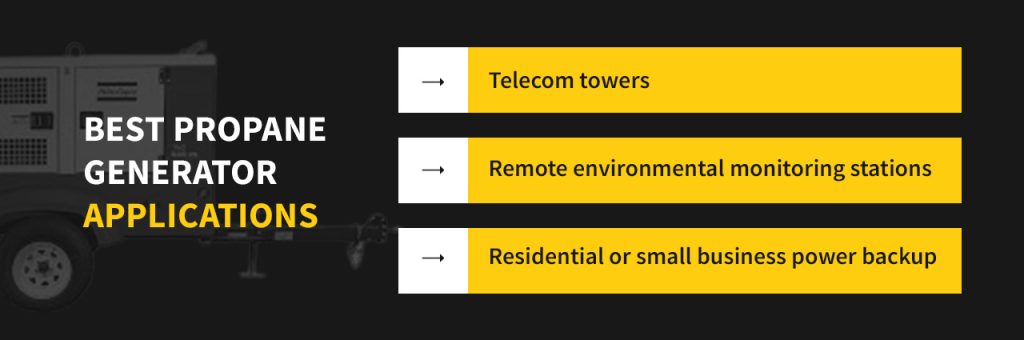
Propane generators are ideal for remote locations with no natural gas pipelines. They are also ideal if cleaner emissions are a priority and you want to avoid diesel fumes. Opt for a propane generator for the following applications:
Propane’s indefinite shelf life means that it will not degrade over time like diesel. This makes it a great option for backup generators that may sit unused for long periods. Propane’s longevity ensures that it is always ready for operation, especially in emergency situations. This also minimizes maintenance needs by reducing refueling frequency.
Propane generators require physical on-site tanks, so you must plan for storage, delivery and replacement. Another important consideration is propane’s lower energy density. This means that a propane generator burns more fuel to generate the same amount of power as alternative options.
Battery energy storage systems (BESSs) are a modern, efficient fuel option. Their silent, emission-free operation makes them a popular solution, and you can utilize them in hybrid setups.
BESSs are best suited for noise-sensitive areas. Choose this option for applications such as:
A battery energy storage system provides power with zero localized emissions, which contributes to cleaner air quality. They also operate without noise, which makes it easier to work in noise-sensitive environments. These advantages can limit disturbances to neighborhoods and the environment, which improves community relations.
A hybrid setup combines battery and diesel power for increased efficiency. Consider pairing a battery energy storage system with a traditional diesel generator to conserve power and save money. In this system, a battery efficiently handles low loads such as site lighting or security cameras. The diesel generator activates to recharge the battery or manage peak power demand periods. This combination optimizes fuel consumption and generator run-time, preventing the diesel generator from running at low loads for long periods.
Choosing the optimal generator rental hinges on aligning the fuel type with your specific project demands and priorities:
Always consult with an engineer to accurately size your load and ensure the most efficient and cost-effective power solution for your jobsite’s needs.
Various fuel options are available for generator rentals, each one offering specific advantages. Foley Power Systems Rentals offers comprehensive power solutions and tailors them to your specific project needs. You can trust our consultants to assess your site and understand your operational constraints, helping you choose the ideal generator. Contact us to request a quote or learn more about securing reliable, efficient temporary power for your next project.