
Join Our Email List!

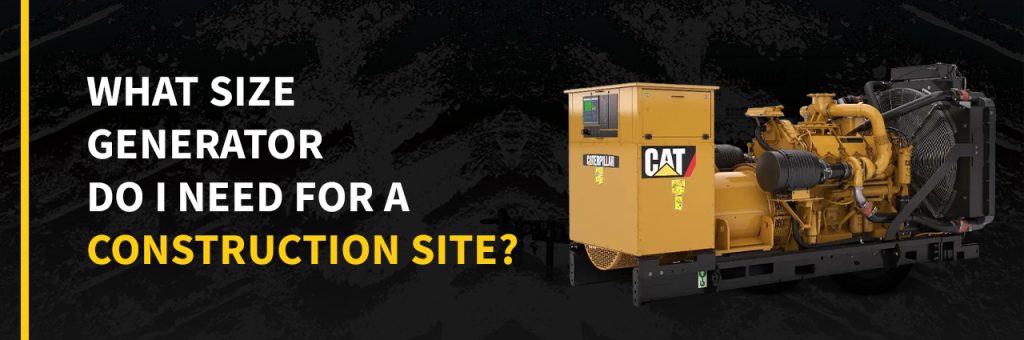
Choosing the right generator size is essential for efficiency, reliability, cost savings and equipment longevity. While you may feel tempted to “go big” for peace of mind, an oversized generator can be just as challenging or costly as an undersized one. The goal is to choose a generator that supports your operations while keeping your overhead costs as low as possible.
Generator sizing matters because it impacts various parts of your operations and budget. Providing adequate temporary power for construction sites is the main concern, but choosing the right size also helps you:
A generator that is too small for your site’s demands can introduce problems. An undersized unit frequently trips breakers, bringing your work to a sudden halt. When a generator cannot handle your equipment’s needs, it may delay your projects and impact productivity.
Opting for insufficient power can also damage your connected tools and equipment. Voltage drops can overload a generator and may lead to damage or premature equipment failure. This constant struggle for adequate power leads to lost work hours and an unsafe work environment for your crew.
Choosing an excessively large generator also brings its own complications. The main concern is “wet stacking,” which is when a diesel engine runs constantly with a very small load. This causes unburned fuel to accumulate in the exhaust system. When unburned fuel builds up, it can reduce efficiency, damage the engine and increase repair needs.
Operating a massive engine for small loads also wastes fuel. This can significantly inflate your budget and impact your company’s profit margins.
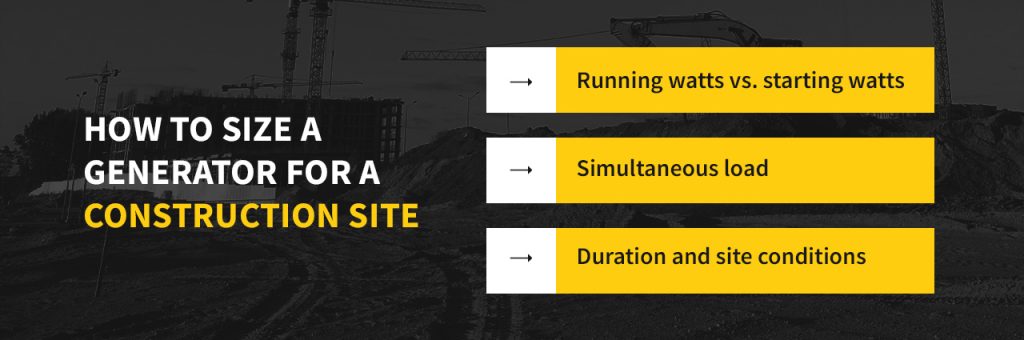
Focus on these elements to choose a generator that meets your exact project needs:
Categorizing generators by their typical applications can help simplify your selection. Review the following categories to determine which generator type best matches your project’s equipment and scope.
Small generators provide portable, localized power for individual tasks or smaller construction crews. A small generator is typically ideal for handheld tools and applications such as:
A medium generator is an excellent option if your construction site requires more consistent, substantial power for larger operations. They balance size and power output for diverse construction needs. Opt for a medium generator if you need to power the following types of equipment:
The most demanding construction projects require large generators. A large generator delivers the immense power you need to run heavy machinery and support entire site operations. These powerhouse units can energize equipment such as:
A large generator can also serve as a construction site’s primary power grid. Large units provide reliable electricity to all operations when grid power is insufficient or unavailable. They are engineered for continuous, heavy-duty performance and can help your biggest projects run smoothly.
Manual calculations and estimations are not always accurate. Advanced tools, such as the Cat® Electric Power SpecSizer, simplify the generator sizing process. The Cat Electric Power SpecSizer is a specialized tool that helps you save time and find the right generator. It bridges the gap between general understanding and precise technical requirements, optimizing your project planning.
The Electric Power SpecSizer eliminates the need for manual math, replacing guesswork with data-driven precision. This advanced online tool accounts for complex factors such as transient response, load steps and voltage dip analysis. It simulates real-world scenarios to tailor accurate recommendations to your specific power needs. When you use the SpecSizer tool, you can trust that your generator will perform efficiently.
While the SpecSizer tool provides accurate recommendations, expert consultation is still essential. Software delivers precise technical calculations, but an equipment expert provides real-world experience and understands construction site dynamics. Foley, Incorporated’s experienced professionals can assess critical factors, such as the following, to help you select the best generator:
The best approach is to combine technological insight with seasoned professional advice. This ensures you factor every aspect of your power solution into your decision.
The best option depends on your long-term business strategy and typical project characteristics. Renting and buying each present unique advantages, and the right choice can significantly impact your budget and operational flexibility.
Renting a generator is often best for short-term or seasonal projects. It offers maximum flexibility without the costs of ownership. Renting is also a great way to test a specific generator before deciding to purchase.
Buying a new generator is ideal for long-term project needs. If you plan to use it daily over extended periods, a high-quality generator is often a cost-effective investment. A used generator is another excellent option if you want to purchase a unit on a limited budget. Foley, Incorporated buys and sells power equipment.
Selecting a generator size for your construction project is a crucial decision. Choosing the right generator helps you save money, protect your equipment and keep each project on schedule. Trust the SpecSizer tool and the Foley, Incorporated team for accurate recommendations that meet your jobsite needs. Our experts have the knowledge and experience to help you select the ideal generator size for every project.
Explore the SpecSizer tool or contact us to learn more about our wide inventory of generators.